AI search · Strategy and implementation
Generative Search Optimization: What It Is and How to Start
Learn what generative search optimization is, where SEO, AEO and GEO overlap, and how to turn customer questions into useful content and a measurable 90-day plan.
What is generative search optimization?
Generative search optimization is the practice of making a website’s information easier to discover, interpret and use in AI-assisted search experiences. It brings together technical SEO, clear business identity, useful explanations and verifiable evidence. The objective is to help a relevant source answer a real question, while giving the reader a reason to visit and act.
Names such as GEO, AEO and AI SEO describe overlapping approaches rather than universally agreed standards. Generative search optimization is also sometimes shortened to GSO. For a business, the practical question is the same: can a search system find an accurate explanation of your service, and does that explanation help a prospective customer make a decision?
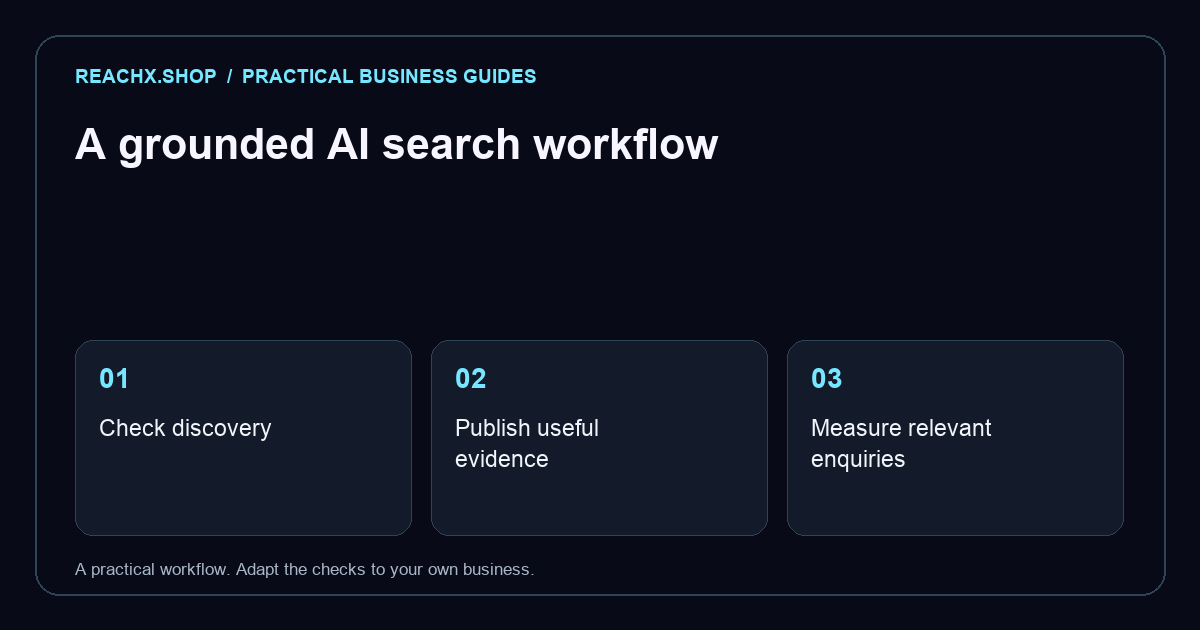
Start with three checks:
- Can search engines reach and index the right page? Check crawl access, the canonical URL and Search Console inspection.
- Does it answer an actual customer question? Map relevant queries to one useful service page or guide, with evidence readers can verify.
- Can you measure the result? Record relevant impressions, clicks and qualified enquiries before changing the page, then compare consistent periods.
This guide separates implementation choices from platform requirements. Recommendations below are a working framework, not a claim about a secret ranking algorithm. Google says its existing SEO practices remain applicable to AI features, without a separate set of special optimizations. Other answer platforms have their own discovery systems; Google guidance should not be treated as documentation for all of them.
Separate SEO, AEO and GEO by the customer task
| Approach | Useful question | Practical output |
|---|---|---|
| SEO | Can the right page be discovered for a relevant search? | Crawlable pages, clear topics, useful titles and connected navigation. |
| AEO | Does a section directly resolve the visitor’s question? | A concise answer followed by qualifications, examples and next steps. |
| GEO / GSO | Can a complex answer use this information accurately? | Consistent entities, explicit comparisons, original evidence and context. |
Do not create three near-identical pages for these labels. Assign a primary purpose to each URL. A commercial service page explains scope, deliverables and how to enquire. An educational guide explains the method, limitations and implementation. Link them where a reader naturally moves from learning to evaluating help.
Build an intent map from Search Console evidence
Start with Search Console’s Performance report. Select Web search, choose a meaningful period and inspect queries alongside their landing pages. Compare equal periods, then segment by country and device only where there is enough data. Google can hide some low-volume queries for privacy, so the visible query rows are not a complete account of every click.
- Group by problem: separate definitions, comparisons, implementation questions and requests for a provider. Keep branded searches in their own group.
- Choose a destination: map each group to the page that actually resolves that intent. Inspect the query’s Pages tab before assuming the homepage should target it.
- Identify the gap: decide whether the page needs clearer copy, more evidence, a better title or a new supporting guide. Avoid creating a URL just for a spelling variation.
- Record the hypothesis: write down what you will change, the intended audience and how you will evaluate it.
A query with ten impressions and no clicks is a topic signal, not evidence that a title has failed. Its position, intent, search layout and sample size all matter. A similarly spelled brand belonging to another company is not an invitation to target that company’s customers with misleading copy.
Design a topic structure with one purpose per page
Build a compact content system around the questions customers actually ask. For a web agency, the service page can describe generative search optimization support; a guide can explain the process; a technical SEO page can explain crawlability and indexing work. Each should add distinct information.
Create a simple inventory with URL, primary intent, owner, evidence needed and next review date. Where two pages answer the same question, consolidate the useful material or make their purposes clearer before expanding. Use descriptive internal links in the relevant paragraph, not a large block of repeated exact-match anchors.
Keep important information in accessible page text. A visitor should not need to open a modal, watch a video or complete a form to understand what the business does. Use stable, descriptive URLs and retain an established URL when improving its content. A title change alone is rarely a reason to change an address.
Make every important claim inspectable
Strong content gives readers something they can verify. Explain the method behind an audit, show a real deliverable with permission, or publish a clearly labelled worked example. Where there is no measured result, say so. A hypothetical example should never be presented as a client case study.
For each material claim, identify the source, date, scope and limitation. Place the source near the claim. Distinguish official platform requirements from your own recommendations. If you cite a performance improvement, describe the baseline, time window, sample size and other changes that could have influenced it.
Give each important section enough context to make sense independently: name the subject, state the answer, explain the conditions and show an example. Avoid filling the page with short repetitive answers. A useful comparison includes the tradeoffs that affect a real decision, such as ownership, maintenance effort, required content and measurement access.
Google’s people-first content guidance emphasises originality, reliability and usefulness. An editorial review should therefore ask whether a reader can accomplish something after reading the page, rather than count keyword occurrences.
Verify crawlability, canonical signals and structured data
Before expanding content, confirm that the intended URL returns a successful response, can be crawled, is indexable and points to the correct canonical. Check that internal links and the XML sitemap use the same preferred address. Use URL Inspection to distinguish a page that is available on the web from one Google has actually indexed.
- Check the rendered main content, mobile navigation and key links.
- Review robots directives and snippet controls for accidental restrictions.
- Use a self-consistent canonical on original pages; investigate conflicting duplicates.
- Maintain sitemap modification dates when the underlying content changes materially.
- Describe articles, organizations and breadcrumbs accurately in structured data, matching the visible page.
- Test the enquiry journey and mobile usability after changing templates.
Google’s published eligibility requirements for AI supporting links include indexing and eligibility for a Search snippet. Its documentation says no special AI schema or new AI text file is required. Adding an llms.txt file, a custom “AI score” or FAQ markup does not establish Google AI eligibility or guarantee a citation. Use structured data for accurate description, not as a substitute for substance.
For implementation help, see Reach X’s technical SEO services and mobile website speed checklist.
Worked example: improve a service page without duplicating it
Illustrative scenario: a small agency has a page headed “AI solutions” and an introduction saying it delivers “next-generation growth.” A visitor cannot tell whether it offers content strategy, software, search audits or paid advertising.
Replace the vague heading with the actual service, explain who it serves and list concrete deliverables: a crawl and indexability review, an intent-to-page map, an editorial brief and a measurement baseline. Describe what the client receives and which inputs are required. Add a short explanation of the process and a realistic statement about factors outside the agency’s control.
Keep detailed implementation education in a linked guide. On the service page, answer commercial questions: what is included, how scope is agreed and how to start. On the guide, explain the methods. This creates two useful destinations instead of two pages competing to provide the same answer. This example is a planning exercise, not a claim of traffic growth.
Measure search visibility and qualified demand separately
Use a scorecard with three layers: technical availability, discovery and business outcomes. The first checks indexability and rendering. The second tracks relevant query groups and landing-page performance. The third records qualified enquiries or another meaningful conversion with appropriate analytics and privacy controls.
For query groups, compare clicks and impressions together. CTR equals clicks divided by impressions, but a change in query mix or position can change CTR without any change in copy quality. Average position is an aggregate, not a fixed rank. A visibility increase with no qualified enquiries may indicate a mismatch between informational traffic and the offer.
Use the Search Console reports available in your account and read each report’s definitions before interpreting AI visibility. Do not label every Web click as an AI referral. Search Console and analytics measure different things, so their totals need not match. A manual sample of AI answers can help discover issues, but record the prompt, platform, date and context; a single answer is not a stable ranking report.
As an optional prioritisation estimate, multiply relevant impressions by the gap between current CTR and a realistic comparison group’s CTR. Compare similar positions, devices and intent. This estimates where to investigate; it is not a forecast of guaranteed additional clicks.
A 90-day implementation and review plan
Days 1–14: establish the baseline
Inventory important URLs, review indexing and select a small group of commercially relevant topics. Save the current metadata, query-page relationships and conversion definitions. Record low-volume or incomplete data so later comparisons do not imply more certainty than the evidence supports.
Days 15–30: improve the core pages
Fix technical blockers first. Improve a focused service page and publish one substantial supporting guide. Add useful internal links, accurate structured data and a sitemap entry. Verify the live result on a phone and desktop, then request recrawling through the appropriate Search Console workflow when available.
Days 31–60: examine discovery
Check indexing and new query-page relationships. Look for relevant impressions, unexpected landing pages and questions the content still leaves unanswered. Correct actual gaps without repeatedly changing titles based on a handful of impressions. Keep a change log to make the review interpretable.
Days 61–90: evaluate business value
Compare equal, sufficiently complete periods and review enquiry quality. Consider seasonality, campaigns and unrelated site changes. Expand the next topic only when it serves a distinct customer need. Ninety days is a review schedule, not a promise that indexing, rankings or leads will reach a particular level.
Questions businesses ask before starting
Does generative search optimization replace SEO?
No. Crawlability, useful information, clear navigation and trustworthy business details remain part of the same foundation. The additional planning focus is on answering complex questions with enough evidence and context.
Can anyone guarantee a citation in an AI answer?
No. Selection depends on the platform, question and context. A responsible scope describes the work and measurement, rather than selling guaranteed placements.
Should every page target generative search optimization?
No. Use the topic only where it describes the page. Product, location and other service pages should retain their own customer purpose. A focused guide and a relevant service page are a better starting point than site-wide repetition.
What should I prepare for an audit?
Bring your public website, priority services, intended market and a definition of a qualified enquiry. Where you can provide access, use Search Console query and landing-page data to help set priorities. Explore Reach X’s generative search optimization services or request a website and SEO audit.
Sources and editorial notes
Published by ReachX.shop on 16 October 2026. This guide presents an implementation framework; it does not report an original ranking experiment or client results. Platform documentation can change, so check the linked requirements during implementation.
- Google Search Central: AI features and your website — eligibility, technical foundations and platform-specific guidance.
- Google Search Central: Creating helpful, reliable, people-first content — editorial quality and reliability.
- Google Search Console: Performance report — metric definitions and reporting limitations.