Website strategy
Landing Page vs Website: Which Should Your Business Build First?
A focused landing page can support one offer, while a full website helps visitors explore a broader business. Use this comparison to choose a sensible starting point and plan what comes next.
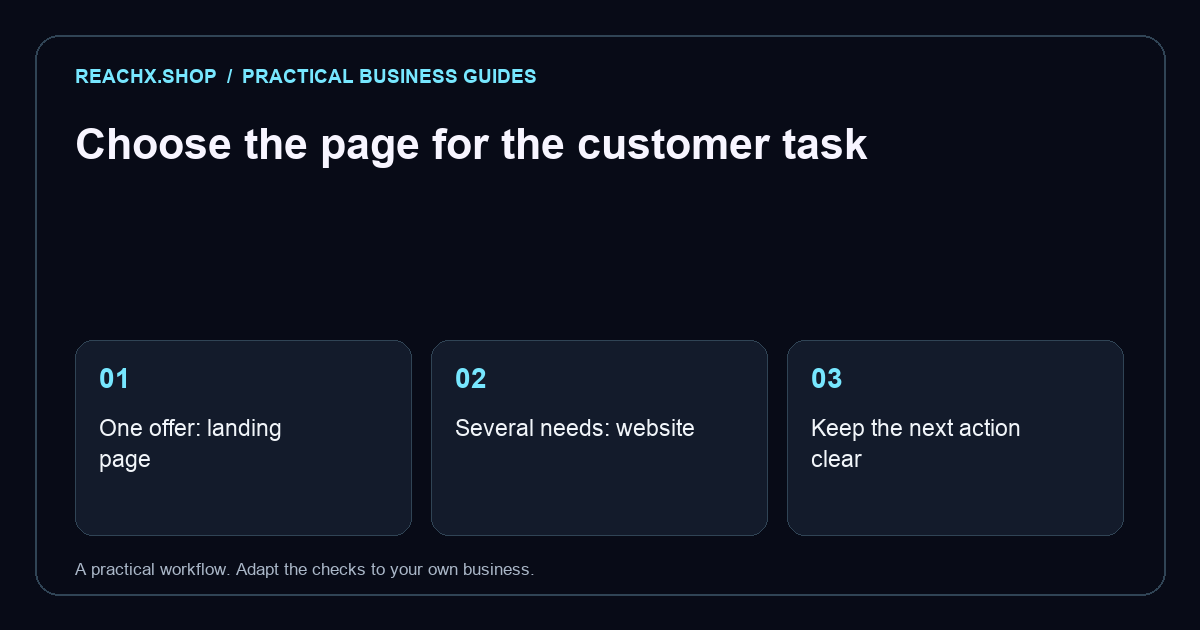
Start with the decision you want a visitor to make. If you need people to book one service, register for an event or enquire about a specific offer, a landing page may be enough. If customers need to compare several services, explore products or understand your business before contacting you, a full website is usually the more useful starting point.
The right choice depends on your offer, audience and sales process. A larger site is not automatically a better fit.
What is the difference?
A landing page is a web page built around one offer and one primary action. Its headline, explanation, supporting evidence and form should help visitors make that decision.
A full website gives customers several connected routes: learning about the company, reviewing services, comparing options and finding contact information. An online store also needs product browsing and a purchase process.
These options can work together. A landing page can sit within an existing website, and a focused first page can later become part of a broader site.
A practical comparison
| Decision | Landing page | Full website |
|---|---|---|
| Main objective | Generate enquiries or registrations for one offer | Explain the business and support several customer journeys |
| Pages needed | Usually one focused page, with necessary supporting information | Separate pages for distinct services, products and company information |
| Traffic source | A specific ad, email, social post or search query | Brand searches, referrals, organic discovery and multiple campaigns |
| Customer decision | A clear next step after a focused explanation | Research, comparison or browsing before taking action |
| Maintenance | Keep the offer, form and campaign message current | Review content, navigation and functions across the site |
Fewer pages do not mean there is nothing to maintain. Forms, links and offer details still need regular checks. Multiple landing pages can also become a substantial collection to manage.
Three examples of what to build first
The following are hypothetical business examples, not ReachX client projects.
Example 1: An independent consultant launching a workshop. The consultant has one event, one audience and one registration goal. A landing page can explain the topic, who should attend, the schedule and the next step. A larger website becomes useful when there are several workshops or consulting services to explore.
Example 2: A service business with several distinct offers. A property maintenance company provides cleaning, repairs and ongoing maintenance. Customers need to understand what each service includes. A full website with separate service pages gives them a clearer route than one long page containing every offer.
Example 3: A retailer selling a product range. A homeware business needs customers to browse products, review delivery information and complete purchases. It should prioritise an ecommerce website with those functions. A promotional landing page can support a particular collection later, while the store handles the transaction.
Keep the campaign promise consistent
A visitor should recognise the offer they clicked. If an email promotes a workshop for new managers, the destination should introduce that workshop and audience clearly. A general homepage makes visitors search again for the promise that attracted them.
Separate campaign pages are useful when the audience, offer or intent meaningfully differs. You do not need a new page merely because the same offer appears in both an email and a social post. Ask whether those visitors need a different explanation or next step.
Does a full website have an SEO advantage?
A single landing page can be eligible for Google indexing. Google's technical requirements concern whether a page is accessible, works and contains indexable content; meeting those requirements does not guarantee indexing. Google Search technical requirements.
More pages do not automatically produce better rankings. Add pages when they answer distinct customer questions, and keep the content useful and well organised. Google's guidance emphasises those qualities and makes clear that no tactic automatically delivers first-place rankings. Google's SEO Starter Guide.
Mistakes to avoid
- Asking one page to explain unrelated offers to unrelated audiences.
- Building extra pages without a clear purpose for each one.
- Choosing the page count before deciding what customers need to know.
- Sending campaign traffic to a page that does not continue its message.
- Launching without checking the mobile experience and enquiry or purchase process.
Frequently asked questions
Can I start with a landing page and expand later?
Yes. Plan the domain, content and enquiries process so the first page can remain useful as the business grows.
Do I need both a website and landing pages?
Sometimes. The website can explain the broader business, while landing pages serve offers that need a more focused route.
Can a landing page sell products?
It can present an offer and lead to a purchase. If shoppers need a catalogue, cart and checkout, include the store functions that their journey requires.
Choose your starting point around the next customer decision. Explore ReachX's landing page development or website development services to see which approach fits your brief.